

Being one of the oldest and most traditional genres in videogames, fighting games represent one of the purest competitive experiences in the medium, demanding mechanical mastery and psychological warfare against a human opponent.
While today’s hits feature cinematic storylines and photorealistic visuals, the foundation was built in 1984 with titles like Karate Champ, which introduced the concept of one-on-one martial arts combat. The landscape shifted forever in 1991 with the release of Street Fighter II, a cultural landmark that popularized the combo system and defined the archetypes still used in modern competitive play.
Over the course of decades, the fighting genre has evolved and changed, but its core remains the same—a fact that allows us to have opinions on which are the best of them. So here are our picks for the 10 best fighting games of all time, ranked from worst to best. Read on and tell us your favorites in the comments!
10. Skullgirls
Developed by Reverge Labs and published by Autumn Games, Skullgirls first arrived on consoles like the PlayStation 3 and Xbox 360 in 2012, eventually finding its definitive form as Skullgirls 2nd Encore on PC, PlayStation 4, and Xbox One.
As an indie game in a genre otherwise dominated by Warners and Capcoms, this little standout proved that a small studio could compete with industry titans by offering a Western take on the hyper-fast anime fighter subgenre. Its hand-drawn art style is visually stunning, offering a unique aesthetic that sets it apart from its more traditional peers.
The game is celebrated for its deep technicality, allowing players to customize their teams with one, two, or three characters to balance power and versatility. Beyond the flashy visuals, it features a highly fluid combat system and a creative combo structure that has sustained a dedicated, loyal community for over a decade. It remains an essential title for players who want a technical challenge wrapped in a gorgeous, cartoonish presentation.
9. Soulcalibur II
People who know Soulcalibur for its most recent games have no clue what it was like when the internet was just grasslands (yes, I am “English-fying” a Brazilian expression). Project Soul and Namco delivered a masterpiece of weapon-based combat with Soulcalibur II, at a time when arcade fighting was still very traditional, without some of the fluff we see on the franchise’s later iterations—not that those are bad, mind you: it’s just that…there’s something about Soulcalibur II’s very basic nature that makes it stand out more.
And, in true Soulcalibur fashion, this title refined the series’ focus on swords, spears, and axes, utilizing a tridimensional arena that allowed for intuitive 360-degree movement. It remains a high-water mark for the series, remembered for its fluid animation and accessibility.
The game’s reputation is bolstered by its exceptional single-player content, a rarity for the genre at the time, which allowed solo players to enjoy a robust progression system. It also became famous for its platform-exclusive guest characters, such as Link on the GameCube version, which helped bring new audiences to the fighting game scene. Even decades later, it is hailed for its perfect balance of tactical swordplay and cinematic spectacle.
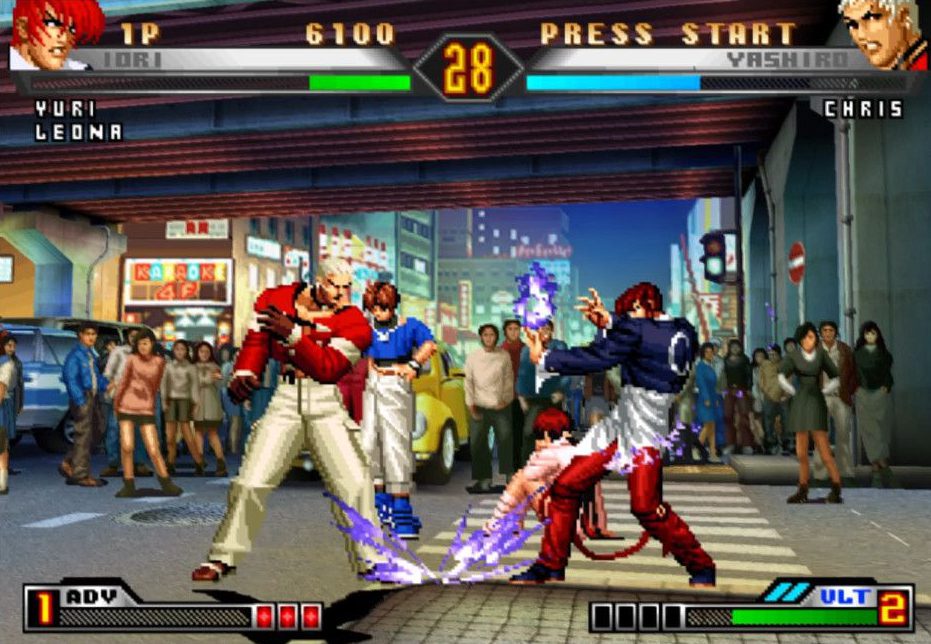
8. The King of Fighters ’98
Released by SNK in 1998 for the Neo Geo arcade and home system, The King of Fighters ’98—subtitled Dream Match Never Ends—is frequently cited as the pinnacle of a legendary series that made its fame by answering a timeless question: “what if the character from game A fought the character from game B?” And boy, did they deliver…
Because it was designed as a “special edition” that ignored the ongoing story timeline, The King of Fighters 98 gathered a massive roster of fan-favorite characters from previous years, including the return of the iconic boss Rugal Bernstein, and refined the franchise’s signature 3-on-3 team format, a groundbreaking mechanic that allows players to master multiple fighting styles in a single match.
The game is praised for its exceptional balance and tight mechanics, offering two distinct playing styles—Advance and Extra—to cater to different competitive preferences. Its impact was particularly strong in East Asia and Latin America (“bora jogar um kings”, or “Let’s play some kings” in literal translation, became so popular an expression that catered to pretty much every demographic, from jocks and nerds through goths, girls…), where its cabinets became staples of local competitive scenes.
Decades later, it remains a benchmark for 2D fighting games, celebrated for its fluid animation, deep strategy, and the sheer joy of its diverse character combinations.
7. Marvel vs. Capcom 2: New Age of Heroes
Released in 2000 by Capcom for arcades and the Sega Dreamcast, Marvel vs. Capcom 2: New Age of Heroes is often cited as the ultimate crossover sequel. It radically advanced the franchise by introducing a massive roster of over 50 characters and a signature 3-on-3 tag-team system.
The game transitioned the series into a faster, more chaotic style of play, supported by a streamlined button layout that invited both casual fans and hardcore competitors.
The innovation seen in this entry provided a lasting blueprint for tag-team fighters, featuring new animations and varied movesets that encouraged creative team synergy. Its jazz-influenced soundtrack and vibrant, colorful visuals helped it stand out in a crowded arcade market. It is remembered not just for the novelty of its character pairings, but for the frantic, screen-filling special moves that made every match a visual event.
6. Mortal Kombat 1
The 2023 release of Mortal Kombat 1 by NetherRealm Studios and Warner Bros. Games served as a bold reinvention for one of the industry’s most iconic franchises.
Available on PlayStation 5, Xbox Series X/S, PC, and Nintendo Switch, the game utilizes a new timeline to reimagine classic characters and introduce the “Kameo” system, which allows players to call on secondary fighters for assists during combat. This addition adds a layer of strategic depth to the series’ trademark brutal action.
The title is lauded for its high-budget, cinematic story mode, which plays like a major action film and provides a deep narrative hook for solo players. Despite its focus on presentation and over-the-top fatalities, the core gameplay remains refined and accessible, offering a faster pace than its predecessors. It represents the franchise at its most modern and feature-complete, successfully blending gore with genuine mechanical innovation.
5. Guilty Gear Strive
Arc System Works redefined the modern anime fighter with the 2021 release of Guilty Gear Strive on PlayStation 4, PlayStation 5, Xbox, and PC. The title is widely considered one of the most beautiful fighting games ever made, using 3D models that are so finely detailed they appear as hand-drawn anime cells in motion, while successfully reinventing a complex series for a new generation, offering deliberate, high-commitment gameplay that rewards precision and rhythmic mastery.
While it maintains the series’ reputation for bombastic characters and a heavy metal soundtrack, it simplified certain mechanics to make the entry point more welcoming for newcomers without sacrificing depth. The inclusion of robust rollback netcode was a turning point for the franchise, ensuring that competitive matches remained smooth even in an online environment.
It currently stands as a titan of the tournament scene, beloved for its technical intensity and unmatched style.
4. Super Smash Bros. Ultimate
Nintendo’s 2018 release, Super Smash Bros. Ultimate, is a design miracle that functions as both a chaotic party game and a deep tournament titan.
Developed in collaboration with Sora Ltd. and Bandai Namco for the Nintendo Switch, it features the most ambitious roster in the history of the genre, with nearly 90 playable fighters representing decades of gaming history. Its unique mechanics—focusing on launching opponents off the stage rather than depleting a health bar—set it apart from traditional brawlers.
The game is a massive celebration of the medium, boasting over 100 stages and a robust single-player adventure mode known as the “World of Light”. Its balance is particularly impressive given the sheer size of the cast, and the improved visuals and faster style of play make it feel smoother than any previous entry in the series. It remains one of the best-selling and most-played fighting games of all time, appealing to every level of skill.
3. Tekken 3
When Bandai Namco released Tekken 3 in 1997 for arcades and the original PlayStation, it sparked a revolution that took 3D fighting from a novelty to a legitimate art form. By introducing free movement and fluid sidestepping, it fundamentally changed the dynamics of battle, allowing players to navigate a truly three-dimensional space.
Because of that, the game quickly became a global smash hit, dominating home consoles and setting a benchmark for animation quality that remains impressive today.
The roster introduced soon-to-be legendary characters like Jin Kazama and Hwoarang and utilized sophisticated grapple chains and juggle combos that offered a new kind of combat flow. It was a technical masterpiece for the PlayStation hardware, offering smooth movement and a variety of modes that kept players engaged for years. Decades later, it is still remembered as the title that secured the series’ place alongside the greatest names in the genre.
2. Street Fighter 6
Released in 2023 by Capcom for PlayStation 4, PlayStation 5, Xbox Series X/S, PC, and later the Nintendo Switch 2, Street Fighter 6 is the most accessible and feature-complete entry in the franchise’s history.
This is the game that introduced “Modern Controls,” a scheme designed specifically to lower the barrier to entry by simplifying complex inputs without sacrificing competitive integrity. At the same time, its new “Drive System” provides veteran players with a deep set of offensive and defensive options to master.
The game also broke new ground with “World Tour,” a massive single-player mode that allows players to create their own fighter and explore an open world, learning moves from the series’ icons and implementing a small storyline no different than your less robust RPG.
This combination of a robust solo experience and top-tier rollback netcode for online play has made it the modern standard for the genre. It represents a perfect blend of classic 2D mechanics and fresh technology, ensuring the franchise remains at the top of the competitive world.
1. Street Fighter III: 3rd Strike
For many enthusiasts, Capcom’s Street Fighter III: 3rd Strike, released in 1999 for arcades and later ported to the Dreamcast and PlayStation 2, remains the pinnacle of 2D fighting game design. Its defining feature is the parry system, which transformed defense into an active, high-risk art form that demands perfect timing and strategy. This mechanic led to the single most famous moment in competitive history at EVO 2004, cementing the game’s status as a cultural touchstone.
The game is praised for its focused, intense roster and a gorgeous, sprite-based art style that is still considered unmatched for its fluidity and detail. Unlike entries that favor chaos, 3rd Strike was designed for players who appreciate a thoughtful, strategic approach to combat where every frame counts. It is a game that rewards investment more than almost any other, standing as the definitive challenge for those seeking to master the genre.
Final Thoughts
The fighting game genre is unique in its ability to turn digital competition into a deeply personal test of skill and reaction. From the foundational arcades of the early 90s to the feature-rich masterpieces of today, these games have evolved into cultural institutions that transcend the medium. While the ceiling for mastery is always higher than one might expect, the community and the thrill of improvement make the investment meaningful for every player who steps into the ring.